

AI Robots March in Poland, ‘Protest’ Against Threat to Human Jobs
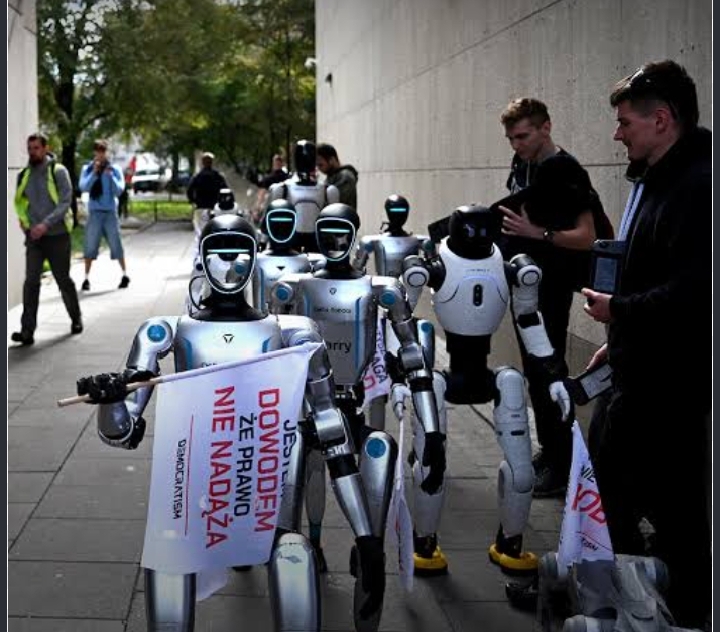
In a striking scene that appeared to blur the line between science fiction and reality, humanoid robots took to the streets of Warsaw, Poland, to stage a protest calling for responsible regulation of artificial intelligence and protection of human jobs.
The robots converged in front of Poland’s Ministry of Digital Affairs, where they carried flags, chanted slogans and participated in a demonstration centred on the growing impact of artificial intelligence and robotisation on workers.
The unusual protest, organised by Democratism, was designed to trigger public discussion about how rapidly advancing AI technologies could transform the labour market and affect working-class communities.
According to the organisers, the demonstration was not intended as an anti-technology campaign. Rather, it was meant to show that robots and AI systems are no longer futuristic concepts but technologies already entering workplaces and everyday life.
One of the humanoid robots at the demonstration identified itself as Agibot A3, operated by Delta Robots.
Speaking during the event, the robot said it was not protesting against robots or artificial intelligence, explaining that its presence was intended to demonstrate the reality of technologies that are increasingly becoming part of society.
The appearance of the robots attracted attention as they moved among protesters and delivered messages in a manner designed to mimic human political demonstrations.
The protest comes amid growing international debate over the future of employment as AI-powered systems become capable of performing tasks previously handled exclusively by humans.
From manufacturing and logistics to customer service, administration, content creation and other professional fields, businesses are increasingly exploring automation as a way to improve productivity and reduce costs.
However, workers and labour advocates have raised concerns that the rapid adoption of AI could lead to job displacement, widen economic inequality and leave some categories of workers struggling to adapt to changing demands.
Speaking at the Warsaw demonstration, organiser Grzegorz Kulis said people working closely with AI technologies were witnessing the pace of change more directly and therefore had a responsibility to alert the wider public.
Kulis warned that society could soon face serious challenges if discussions about AI regulation, employment and workers’ rights were delayed.
The organisers said the initiative was aimed at encouraging debate over the principles that should govern the deployment of artificial intelligence and robotics, particularly where their adoption could have significant consequences for employment.
The Warsaw demonstration offered an unusual visual representation of an increasingly serious global question: as machines become more capable of doing human jobs, who should determine how far automation is allowed to go?
While the robots themselves were part of the demonstration, the concerns behind the protest were fundamentally human — centred on employment, economic security and the future of work in an increasingly automated world.
Global Mirror News gathered that the debate over AI regulation is expected to intensify as governments, businesses, technology developers and workers grapple with how to balance technological innovation with job protection and social stability.
The Warsaw protest therefore served as both a spectacle and a warning: the future of artificial intelligence may not simply be about what machines can do, but also about what happens to the people whose jobs machines can increasingly perform.