

Trump renames Lake Ontario ‘Lake America’ as US-Canada trade war deepens
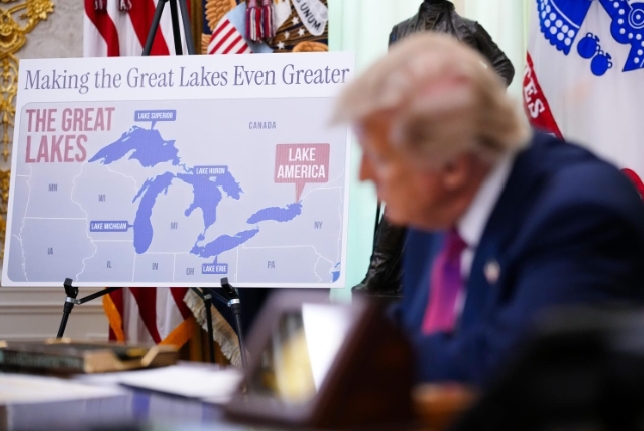
US President Donald Trump has signed an Executive Order directing that Lake Ontario be renamed “Lake America” for official Federal use in the United States, adding a fresh layer of controversy to the escalating trade and diplomatic dispute between Washington and Ottawa.
Trump signed the order on Thursday, August 27, 2026, at the Oval Office and declared that the new name would take effect immediately.
“We’re going to be changing the name of Lake Ontario, effective immediately, to Lake America,” Trump told reporters as he signed the documents.
The US President said his Administration had completed the necessary procedures and notified the relevant authorities to make the change official.
“We filed all the necessary papers, documents, everything else. We notified all of the various people that we have to notify. So we’ve done everything that you have to do, and this is official, effective immediately,” Trump said.
According to the order, the US Department of the Interior and the US Board on Geographic Names are expected to update the federal government’s official geographic naming records to reflect the new designation.
However, Global Mirror News gathered that the change applies to official US Federal usage and does not automatically require Canada, International organisations or private companies to adopt the new name.
Trump attacks Canada over tariffs
Trump used the announcement to intensify his criticism of Canada, accusing Canadian officials of imposing unfair trade barriers against American producers.
“The Canadian officials have created this very badly. They’re nasty people. They charge our farmers 400% tariffs,” Trump said.
His remarks came amid an increasingly bitter trade dispute between the United States and Canada, with both countries imposing or threatening additional tariffs on each other’s products.
The US President has repeatedly argued that Canada has taken advantage of the United States economically, while Canadian officials have rejected the accusations and defended their Country’s trade policies.
Global Mirror News reports that the dispute has become one of the most serious strains in US-Canada relations in recent years, with businesses on both sides facing uncertainty over the impact of the tariff measures.
Canada rejects ‘Lake America’ name
Canadian Prime Minister Mark Carney has rejected Trump’s decision, making it clear that Canada will continue to refer to the body of water as Lake Ontario.
Carney has also accused the United States of attempting to weaken Canada’s sovereignty through economic and political pressure.
The Canadian leader recently broke off trade discussions with Washington and warned that his country would not allow the United States to undermine its independence.
“America is trying to break us so that they can own us,” Carney said, adding that such a situation would “never, ever happen” while he remained prime minister.
The disagreement over the lake’s name has therefore taken on a broader diplomatic significance, coming at a time when relations between the two neighbouring countries are already strained by Trump’s trade policies.
Lake Ontario is shared by US and Canada
Lake Ontario is one of North America’s five Great Lakes and forms part of the international boundary between the United States and Canada.
The lake is bordered by Ontario in Canada to the north and New York State in the United States to the south.
It plays an important role in transportation, shipping, tourism, fishing and recreation and is connected to the wider Great Lakes–St. Lawrence Seaway system.
Because the lake is shared by the two Countries, Canada’s refusal to adopt the new name means the geographical feature could effectively have different official names depending on the Country or Institution making the reference.
Trump previously renamed Gulf of Mexico
The Lake Ontario decision follows Trump’s earlier move to rename the Gulf of Mexico as the “Gulf of America.”
Trump ordered the change shortly after returning to the White House, directing US federal agencies to use the new designation.
Mexico and other international actors, however, have continued using the traditional name, highlighting the limits of unilateral geographical renaming.
While signing the Lake America documents, Trump joked that the next step could involve renaming one of the world’s major oceans.
“If you think about it, we have a gulf and we have a lake. Now, all we need is an ocean,” Trump said.
He added that his administration could potentially consider changing the name of the Atlantic or Pacific Ocean.
US imposes fresh tariffs on Canadian goods
The geographical dispute comes as the economic confrontation between Washington and Ottawa continues to escalate.
Trump’s administration has imposed a new 50 per cent tariff on about $20 billion worth of Canadian goods, with products such as beer, cheese, wine, hockey sticks, cement and electronics among those affected.
The US president has also threatened to increase tariffs on Canadian vehicles, automotive parts and steel.
Canada has responded by preparing retaliatory tariffs against American products.
Carney’s Government has announced that the retaliatory measures are expected to begin on September 8, raising fears of further disruption to cross-border trade.
The United States and Canada have deeply integrated economies, with companies and consumers in both countries relying heavily on cross-border supply chains.
Name change becomes latest symbol of tensions
Although Trump’s executive order changes the name used by the US federal government, it cannot force Canada to abandon the historic name Lake Ontario.
Global Mirror News gathered that geographical names shared across international borders can remain subject to different national naming conventions, particularly where one Country attempts to impose a unilateral change.
The controversy has consequently become another symbol of the widening political and economic gap between Washington and Ottawa.
As the two Governments prepare for another round of tariff measures, the dispute over “Lake America” is likely to remain intertwined with the much larger argument over trade, sovereignty and the future of US-Canada relations.
For now, the body of water remains Lake Ontario in Canada, while the US Federal Government is moving to use Lake America in its official records.