

Norway’s King Harald V Dies at 89 After 35 Years on the Throne
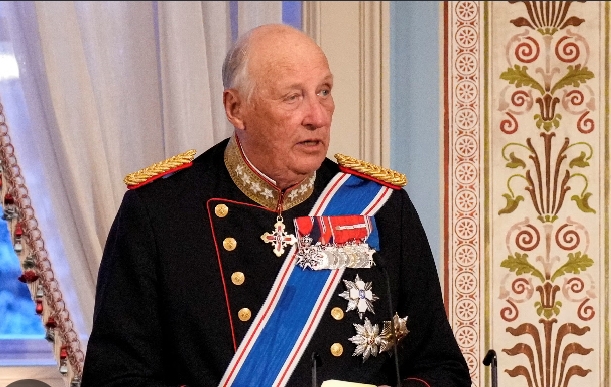
Norway is mourning the death of King Harald V, who passed away at the age of 89 after more than three decades as the Country’s monarch.
The Norwegian Royal Palace announced on Friday that King Harald died peacefully at Oslo University Hospital Rikshospitalet at 6:35 a.m. local time on August 28, 2026.
“It is with deep grief that we announce that His Majesty King Harald has passed away,” the Royal Court said in its official announcement.
Following the announcement, the royal flag at the Palace in Oslo was lowered to half-mast as members of the public began gathering to mourn the monarch and lay flowers in his memory.
King Harald, who became monarch in January 1991 following the death of his father, King Olav V, had served Norway for about 35 years. He was Europe’s oldest reigning monarch at the time of his death.
King Harald’s health deteriorated
The Monarch had been receiving treatment at Oslo University Hospital since August 17 after developing haemolytic anaemia, a condition in which red blood cells are destroyed faster than the body can replace them.
His condition became increasingly serious in the final days of his life. The palace announced on Thursday that his condition had become “extremely serious”, prompting members of the royal family to rush to his bedside.
Queen Sonja, Crown Prince Haakon, Crown Princess Mette-Marit and other members of the family spent much of Thursday at the hospital.
International reports also said the King had been receiving treatment for a bacterial infection in his blood in the period before his death.
Harald had experienced several health challenges in recent years, including infections and other conditions that forced him to reduce his official engagements. He also had a pacemaker fitted.
Despite his declining health, the King repeatedly rejected suggestions that he should abdicate, maintaining that his commitment to the Norwegian monarchy was lifelong.
Haakon succeeds his father
With King Harald’s death, his 53-year-old son, Crown Prince Haakon, becomes Norway’s new monarch.
Haakon has been heir to the Norwegian throne for decades and has frequently acted as regent when his father was unable to perform official duties because of illness or absence.
The Norwegian Royal Court confirms that the line of succession is governed by direct descent, with Crown Prince Haakon first in line, followed by his daughter, Princess Ingrid Alexandra.
Haakon, born on July 20, 1973, is the only son of King Harald and Queen Sonja. He studied political science at the University of California, Berkeley, and later earned a master’s degree in development studies from the London School of Economics.
He also served in the Royal Norwegian Navy and has undertaken extensive official duties on behalf of the Norwegian Crown.
His accession marks another major transition for Norway’s constitutional monarchy.
A king remembered for unity and openness
King Harald was widely regarded as a unifying figure who helped modernise the Norwegian monarchy while maintaining a close relationship with ordinary citizens.
The Norwegian Royal Court described the monarch as the foremost symbol of the Norwegian community, noting his role in representing the country during celebrations as well as periods of national tragedy.
His response to the 2011 terrorist attacks in Norway was particularly remembered. During a period of national grief, Harald delivered messages emphasising tolerance, inclusion and solidarity.
His relatively modest public image also contributed to his popularity. Unlike some European monarchs, Harald cultivated an approachable personality and was frequently seen engaging with Norwegians at public events.
His marriage to Sonja Haraldsen in 1968 was itself regarded as a break with traditional royal expectations because Sonja was a commoner. The couple went on to have two children, Haakon and Princess Märtha Louise.
From Olympic sailor to king
Beyond his royal duties, Harald was passionate about sailing and sport.
He represented Norway at the 1964 Tokyo Olympics and later enjoyed considerable success in competitive sailing, including world and European championship victories. He continued participating in sailing events for decades before ending his competitive career in 2022.
He was also strongly interested in nature and environmental protection and was involved in the Norwegian branch of the World Wide Fund for Nature during his years as Crown Prince.
King Harald’s reign therefore combined traditional constitutional duties with a more modern and accessible style of monarchy.
Difficult period for Norway’s royal family
His death comes at a challenging time for the Norwegian royal household.
In recent months, Crown Princess Mette-Marit has faced intense public scrutiny over her past communications and association with Jeffrey Epstein, the late American financier and convicted sex offender.
Her son, Marius Borg Høiby, has also been at the centre of legal controversy after being convicted on multiple charges and sentenced to prison. He has appealed the verdict.
Mette-Marit has herself faced serious health challenges and underwent a lung transplant in July, adding to the difficulties confronting the royal family.
Despite the controversies, the Norwegian monarchy has retained significant public support, with King Harald’s personal popularity often regarded as one of the institution’s strongest assets.
Norway begins a new royal era
King Harald’s death closes a major chapter in modern Norwegian history.
He became king in 1991 after the death of King Olav V and took an oath to uphold Norway’s Constitution before the Storting four days later. He and Queen Sonja were subsequently consecrated at Nidaros Cathedral in Trondheim.
For more than three decades, Harald served as Norway’s ceremonial head of state, witnessing major political, social and economic changes while maintaining the monarchy’s largely non-political role.
As Norwegians mourn, attention now turns to Crown Prince Haakon and the next chapter of the Norwegian Monarchy.
Global Mirror News gathered that King Harald leaves behind Queen Sonja, Crown Prince Haakon, Princess Märtha Louise, grandchildren and a royal legacy built around national unity, public service and a modern interpretation of the Norwegian Crown.