Beyond the Signing: How Ogun’s $7bn Deep Seaport and Blue Marine SEZ Could Transform Nigeria’s Economy
By Kayode Akinmade
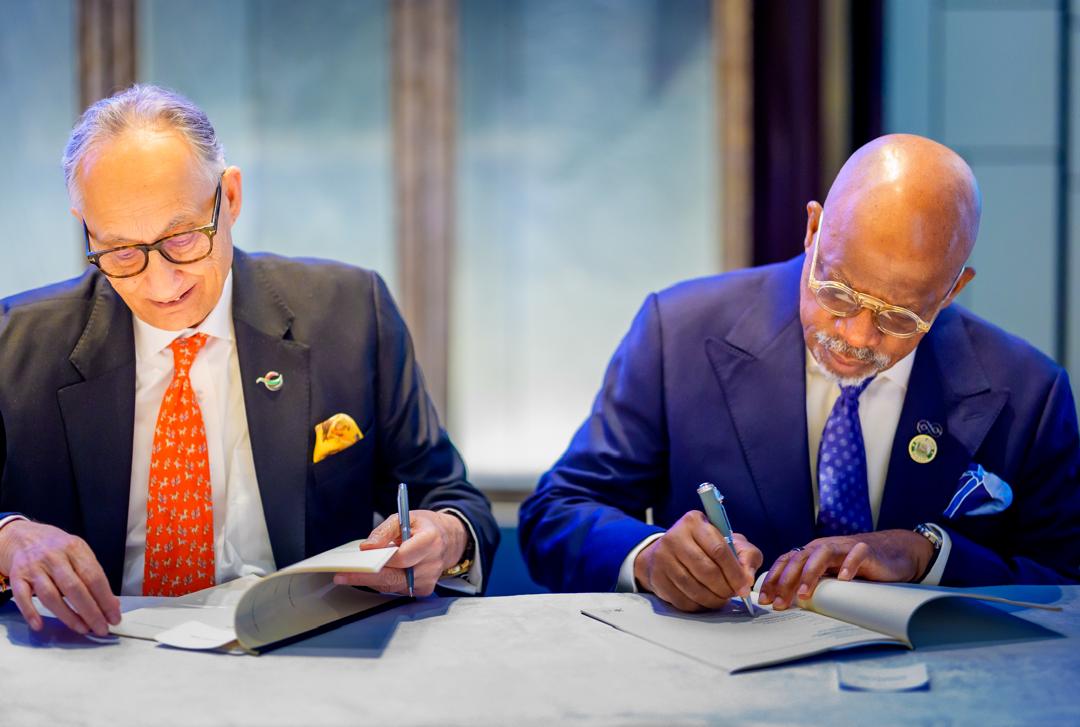
The signing in Paris may have taken place around a table, with documents exchanged and signatures appended, but the significance of what Ogun State and its partners have set in motion extends far beyond the ceremony.
The Memoranda of Understanding signed by the Ogun State Government and DP World for the development of the Gateway Deep Sea Port and the Ogun State Blue Marine Special Economic Zone represent the emergence of a new economic architecture with implications not only for Ogun but for Nigeria’s industrial, maritime and export future.
With an initial investment of more than $7 billion and more than 50,000 direct jobs projected, the initiative has the potential to become one of the most significant private-sector-backed infrastructure and industrial investments in the country.
But the real significance lies beyond the headline figures.
It is the deliberate integration of a deep-sea port with a 10,000-hectare special economic zone that gives the project its transformative character. As President Bola Ahmed Tinubu put it, “A port moves cargo; a port integrated with a special economic zone helps to build an economy.”
That distinction is central to understanding what Ogun is seeking to achieve.
A conventional port primarily provides a gateway for the movement of goods. But a port connected to an industrial and export-processing zone can become the centre of an entire production ecosystem—bringing together manufacturing, logistics, warehousing, processing, technology, agriculture, energy and international trade.
The Gateway Deep Sea Port, with its proposed four-kilometre berth and 18-metre draft, is designed to accommodate larger vessels, ease pressure on the Lagos port corridor and reduce some of the logistics costs and delays associated with moving goods through congested facilities.
The Blue Marine Special Economic Zone gives that infrastructure a productive destination.
Within the zone, imported inputs can be transformed into finished products, while agricultural and other Nigerian raw materials can be processed for export. This means that value that might otherwise be created outside Nigeria can increasingly be captured within the country.
For Ogun, the multiplier effect could be substantial.
The first impact would be industrial expansion. A functioning deep port and integrated economic zone can make the state more attractive to manufacturers seeking efficient access to raw materials, machinery and export markets. Existing industries can expand, while new industrial clusters can emerge around logistics, food processing, petrochemicals, light manufacturing, engineering, packaging and other value-added activities.
The second is job creation beyond the headline figure.
The projected 50,000-plus direct jobs represent only the immediate employment potential. Around those jobs will emerge additional opportunities in transportation, haulage, warehousing, construction, security, catering, maintenance, financial services, professional services, technology and other areas.
The third is the expansion of Ogun’s small and medium-sized enterprise economy.
Large infrastructure projects create markets for smaller businesses. Local suppliers will have opportunities to provide goods and services to manufacturers, logistics operators, construction companies and other businesses within the corridor. If properly integrated into emerging value chains, Ogun’s SMEs could become suppliers and producers within the new economic ecosystem.
The fourth is agricultural transformation.
Ogun has a substantial agricultural base, but production alone does not guarantee prosperity. The real opportunity comes when agricultural commodities are processed, packaged, stored and exported competitively. The Blue Marine Special Economic Zone could provide the industrial and logistics platform for moving agricultural production further up the value chain, creating greater income for farmers and businesses while reducing the export of raw commodities without value addition.
The fifth is logistics and supply-chain development.
The port, the Blue Marine Special Economic Zone, the Gateway International Airport, dry ports and the coastal highway can collectively create a multimodal transportation network. Rather than isolated infrastructure projects, they can operate as interconnected economic assets, allowing goods, people, raw materials and finished products to move more efficiently.
The proposed 28-kilometre Ogun section of the Lagos-Calabar Coastal Highway is particularly important in this regard. President Tinubu described the highway as central to the commercial viability of the emerging corridor, linking the port and industrial zone with Lagos, the Nigerian hinterland and wider African markets.
There is also a fiscal multiplier.
As more businesses establish operations, the economic base from which government derives revenue expands. Increased commercial activity means greater demand for property, transportation, professional services, hospitality and other economic activities. Over time, this can translate into a broader and more diversified revenue base for Ogun.
The project could equally deepen Ogun’s position as an industrial gateway.
The state already possesses a concentration of manufacturing and industrial activities and sits within close proximity to Lagos. The addition of a major deep-sea port and a large integrated economic zone could strengthen that advantage by giving industries located in Ogun more direct access to international shipping and export markets.
But perhaps the most consequential implication is maritime.
For decades, Nigeria has possessed an enormous coastline, a large consumer market and a strategic geographical position along the Gulf of Guinea, yet it has not fully translated these advantages into the kind of maritime dominance its size and economic potential should command.
The Gateway Deep Sea Port could help change that equation.
If successfully developed alongside the Blue Marine Special Economic Zone and the supporting road, rail, airport and logistics infrastructure, Ogun could provide Nigeria with a new maritime gateway capable of attracting larger vessels, facilitating regional trade and connecting Nigerian production more efficiently to international markets.
In doing so, Nigeria could once again—and this time decisively—occupy its pride of place as the maritime hub of the West African subregion.
The ambition should not be limited to serving Nigerian cargo. A truly competitive port can attract transit cargo, regional distribution, trans-shipment and logistics activities from across the subregion. That means Nigeria can move from merely being a large market at the end of global supply chains to becoming a strategic node through which goods move into and out of West Africa.
The economic consequences could be profound.
A stronger maritime ecosystem would stimulate demand for shipping, freight forwarding, warehousing, ship-related services, insurance, finance, customs services, logistics technology, maritime training and a broad range of ancillary businesses. It could also strengthen Nigeria’s capacity to compete for regional trade currently routed through other West African ports.
This is where the Ogun project takes on a significance beyond the boundaries of the state.
Nigeria has long faced the challenge of moving from an economy that exports substantial volumes of raw commodities to one that exports more finished and semi-finished products. An integrated port and industrial zone directly addresses that challenge by creating infrastructure around which production and export can take place.
It can also strengthen Nigeria’s position within the African Continental Free Trade Area by providing a competitive platform for Nigerian manufacturers to produce at scale and reach markets across Africa.
This is why President Tinubu described the initiative as economic diversification and industrialisation made tangible.
For Ogun, however, the story is also about the evolution of the state’s economic identity.
The state has spent years building the infrastructure and investment environment necessary to consolidate its position as Nigeria’s industrial hub. The emerging coastal corridor adds another dimension to that strategy: linking industrial production inland with maritime trade on the coast.
Governor Dapo Abiodun has consistently presented the deep seaport not as a standalone project but as part of a wider multimodal economic vision involving the Gateway International Airport, dry ports, the coastal highway and the Blue Marine Special Economic Zone.
His reference to DP World’s Jebel Ali Free Zone is instructive. The objective is not simply to have ships berth at Ogun’s coastline, but to create an ecosystem in which cargo arriving at the port feeds production, processing, logistics and exports within the wider economy.
The journey to this point, as Abiodun acknowledged in Paris, has involved sustained collaboration among political leadership, government institutions, investors, technical advisers and the host communities.
The governor specifically acknowledged President Bola Ahmed Tinubu for providing the political leadership that helped revive a deep-seaport vision that had remained largely unrealised for more than three decades. He also recognised the contributions of the Minister of Marine and Blue Economy, Adegboyega Oyetola, the Nigerian Ports Authority and other federal institutions for their support.
Abiodun also acknowledged the strategic contributions of DP World, SkyCapital, Supo Sasore Projects and the ALP team, whose investment, advisory, project-development and technical inputs have contributed to advancing the initiative. Equally important, he recognised the host communities, whose cooperation and partnership remain critical to the successful development of the port and the wider Blue Marine economic corridor.
President Tinubu, in turn, commended Governor Abiodun and the Ogun State Government for securing the land, structuring the investment framework and reducing project risks for global investors. He also acknowledged DP World, SkyCapital, financial advisers and other investors and partners whose commitment helped bring the agreements to the signing stage.
That convergence of federal leadership, state initiative, private capital, technical expertise and community partnership is perhaps one of the most important features of the project.
Tinubu described it as “cooperative federalism”—a model in which a subnational government develops a strategic economic vision while the Federal Government provides the institutional, regulatory and infrastructure support required to make that vision investable.
And that may ultimately prove to be as important as the port itself.
Because the real test of the Paris agreements will not be the elegance of the documents or the ceremony surrounding their signing. It will be whether the agreements translate into construction, industries, jobs, exports, businesses, stronger supply chains and measurable improvements in the lives of people.
Governor Abiodun captured that challenge in his own words: “History will judge us not by the elegance of documents signed, but by the transformation that follows. Ceremonies proclaim intentions; only implementation creates prosperity.”
That is the real significance of the Ogun-DP World partnership.
The deep seaport can move cargo. The Blue Marine Special Economic Zone can create the productive capacity to transform that cargo into economic value. The coastal highway can provide connectivity. The airport and dry ports can widen the logistics network. Manufacturers can create products. Farmers can feed processing industries. SMEs can supply emerging value chains. Young people can find new employment opportunities. And exports can travel from Ogun to Nigeria, Africa and the wider world.
If successfully implemented, the initiative could therefore become more than another major infrastructure project.
It could represent a shift from infrastructure as an end in itself to infrastructure as an engine of production, investment and wealth creation.
For Ogun State, that is the game-changing opportunity.
For Nigeria, it is the possibility of turning a coastline into an economic corridor, a port into an industrial gateway and an investment agreement into a broader platform for diversification, export growth and sustainable economic expansion.
More importantly, it offers Nigeria the opportunity to reclaim a strategic position that its size, location and economic potential have long suggested it should occupy: the maritime and logistics hub of West Africa, with Ogun serving as one of the principal engines of that ambition.
The signatures were made in Paris.
The real story—and the real economic transformation—will unfold in Ogun.