

Oleyo Waterfall: Ebute-Igbooro Residents Seek Ogun Govt’s Support for Tourism Development
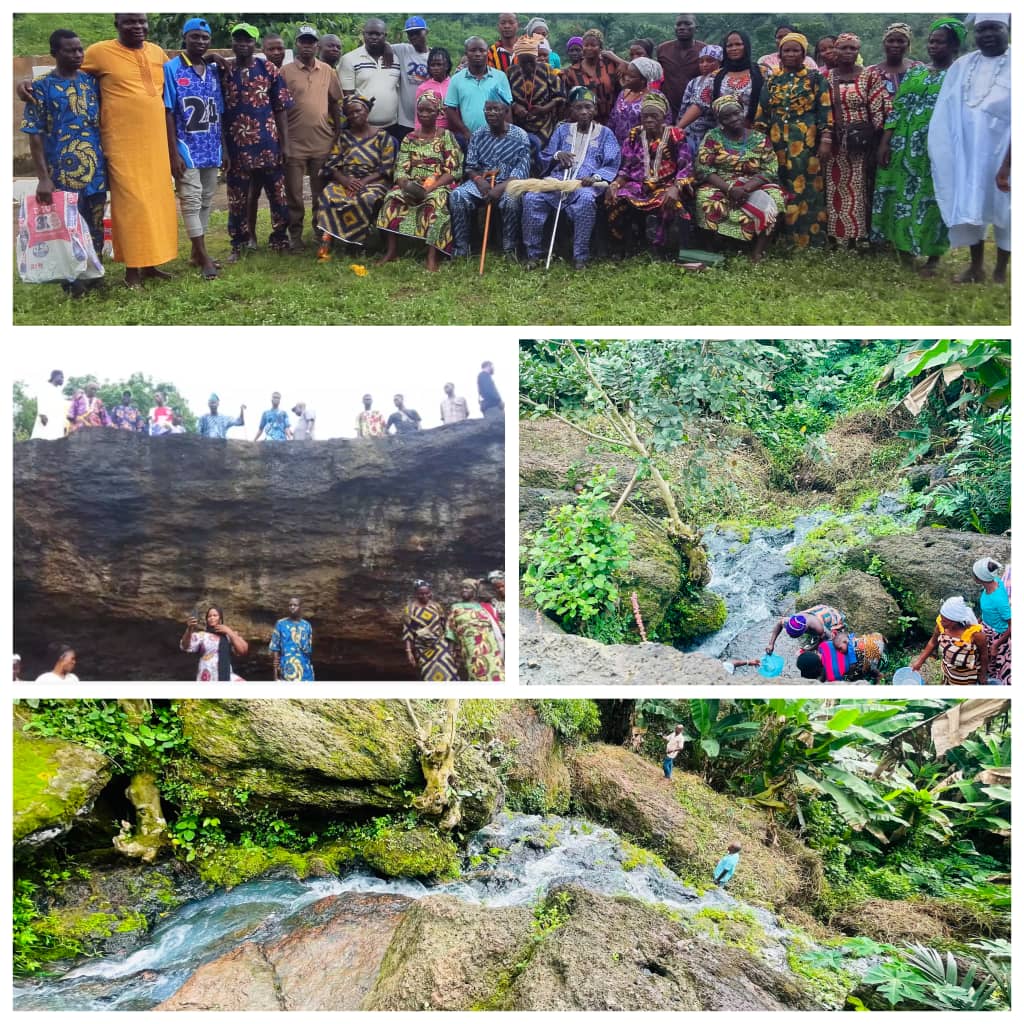
Community Leaders say development of ancient site will boost tourism, jobs and Ogun economy
Residents and Traditional Leaders of Ebute-Igbooro in Yewa North Local Government Area of Ogun State have appealed to the State Government to develop the ancient Oleyo Waterfall into a major cultural and tourism centre.
The appeal was made on Wednesday during a gathering organised to revive and celebrate the traditional heritage associated with Oleyo Waterfall, with community leaders describing the natural spring as a site that has existed for generations and played an important role in the cultural and spiritual life of the people.
The Elebute of Ebute-Igbooro, Alhaji Amusa Adetunji Dosumu, said Oleyo Waterfall was located on Ebute-Igbooro land and had historically maintained a strong relationship with the community.
“Ebute-Igbooro owns Oleyo Waterfall,” he said, stressing the community’s longstanding connection with the site.
The traditional ruler also spoke about the cultural significance attached to the waterfall, saying residents had continued to associate its water with positive experiences and beneficial qualities.
“There are many benefits because this Oleyo water does not tolerate evil. We see that it brings good water,” he said.
Dosumu appealed to the Ogun State Government to support the community in developing and promoting the site as part of efforts to preserve Yoruba cultural heritage and attract visitors.
“We want the government to support us in elevating it, so that everything goes smoothly. Let them assist us; that is what we want the government to do for us,” he said.
Also speaking, the Balogun of Ebute-Igbooro, Chief Jeremiah Ijiola, described Oleyo as a remarkable natural and cultural heritage whose tourism potential had not been fully explored.
Ijiola explained that members of the community had traditionally visited the location to pray, adding that the spring had been associated with indigenous practices for generations.
“Nobody ever thought that something as wonderful and awe-inspiring as this existed here,” he said.
According to him, prayers and traditional activities had historically been conducted at the location, with community members also sharing stories about rainfall occurring during some of such occasions.
“Normally, whenever we come here, we pray. We pray, and once we get here and offer prayers, rain falls,” Ijiola said.
The community leader said the immediate priority was to develop the site in a way that would benefit both residents and the state.
“We want the Ogun State Government to help us turn it into something big. Because with a water spring like this, the government can generate revenue from it,” he said.
He noted that proper development could create another tourism attraction in Ogun State while opening up economic opportunities for residents of Ebute-Igbooro.
“For a water spring like this, if they develop it to be big enough, the government will benefit from it. The state will gain, and the community will gain,” he added.
Ijiola urged the government to take the lead in providing the infrastructure and facilities needed to make Oleyo accessible and attractive to tourists.
He compared the potential of Oleyo Waterfall with the development of Olumo Rock in Abeokuta, saying the natural site could similarly become a destination capable of attracting visitors from different parts of Nigeria and beyond.
“Just like they took care of Olumo, how they renovated Olumo Rock so that it became a tourist centre—where people come from far away distances,” he said.
Ijiola disclosed that government representatives had already visited the location, expressing hope that the visit would be followed by concrete action.
“The Government has sent their representatives. Since they know that when they return, they will give feedback, the government ought to take action to help us develop this place into a tourist centre,” he said.
He further said information available to the community suggested that Oleyo Waterfall was unique within Ogun State.
“From the information I gathered, there is no other waterfall like this in Ogun. This is the first one here,” Ijiola said.
He reiterated the community’s position that the site was located on Ebute-Igbooro land.
“It is on Ebute land itself; Ebute owns this whole area,” he stated.
Another community leader, Alani Olusoja, the Abore of Ebute-Igbooro, said the revival of Oleyo was not only about the waterfall but also about preserving the community’s traditional heritage.
Speaking on the expectations associated with the traditional worship at Oleyo, Alani said the community hoped for peace, abundance and prosperity.
“We should expect peace, abundance, wealth, children, and water in huge abundance,” he said.
He urged indigenes and residents to protect their traditional heritage, warning against abandoning indigenous cultural practices.
“My advice for all of us here today is that traditional heritage (Isese) is vital, it is important. We must not throw away our traditions/heritage,” he said.
Alani explained that the revival followed renewed interest from the traditional ruler, chiefs and indigenes after questions arose about the exact location and history of Oleyo.
“Everyone had abandoned it for a while. Then the King (Kabiyesi), along with all the chiefs and the indigenes, heard about it: ‘Is Oleyo really right here in this spot?’ That was how the whole town was informed,” he said.
He added that the traditional ruler subsequently fixed a date for the community to formally revive the celebration.
“Let Kabiyesi revamp its worship. So Kabiyesi set a date, saying, ‘Today, we want to celebrate its festival,’ which is why all of us gathered here in large numbers to celebrate,” he added.
The Youth Leader of Ebute-Igbooro, Chief Emmanuel Akan, said Oleyo Waterfall was not a recent discovery, explaining that knowledge of its existence and traditional significance had been passed down from one generation to another.
“Oleyo has been here long before we were born. Long before our fathers gave birth to us, we heard that Oleyo was here and that they used to worship it. So, it is not a recent discovery,” Akan said.
He reiterated the community’s claim that the surrounding area belonged to Ebute-Igbooro, adding that their forefathers had historically used and revered the site.
“The fathers before us who gave birth to my own parents were already worshipping it here in Ebute,” he said.
Akan also spoke about growing interest in the waterfall, claiming that people from different parts of Nigeria and outside the country had been visiting the location to collect the water for prayers and traditional purposes.
“As it is right now, people come all the way from abroad, from Abuja, and from everywhere to fetch this water,” he said.
Akan appealed to the Ogun State Government to intervene by providing infrastructure and helping the community transform the location into a modern cultural and tourism destination.
“We want the government to assist us with it—to help elevate our Yoruba cultural heritage, to modernise it, and to turn it into something great and remarkable,” he said.
He specifically called for improved access roads, fencing, renovation and other basic facilities to make the location safer and more suitable for visitors.
“We want the government to assist us with access roads leading here, to help modernise it, and to help build a proper fence and renovate it so that it becomes a modern destination,” he said.
Akan expressed optimism that government intervention could transform Oleyo Waterfall into a major cultural attraction, comparing its potential with the Osun-Osogbo Sacred Grove.
“In fact, if the government helps us, it could even surpass Osun-Osogbo. It can grow bigger and better than Osun-Osogbo,” he said.
Also speaking, Akeweje of Ebute-Igbooro, Chief Obasanjo Ojugbele, urged the Ogun State Government to fast-track the development of the waterfall, saying such an intervention could contribute to the growth of the state’s economy.
Ojugbele said the development of Oleyo would not only preserve the cultural heritage of Ebute-Igbooro but could also stimulate economic activities through tourism, create opportunities for local residents and generate additional revenue for the state.
He therefore called on the government to treat the development of the site as a priority and work with the traditional institution and the community to establish the necessary infrastructure.
The community leaders said the development of Oleyo should include good access roads, proper fencing, visitor facilities, environmental protection measures and other infrastructure required to make the location a viable tourism destination.
They maintained that collaboration between the Ogun State Government, traditional institutions and the local community would be important to ensure that the development respects the cultural values attached to Oleyo while providing modern facilities for tourists and visitors.
Global Mirror News reports that the call by the Ebute-Igbooro community comes amid growing interest in the use of cultural heritage, natural attractions and traditional sites to promote tourism and create economic opportunities at the grassroots.
The residents said a properly developed Oleyo Waterfall could become another attraction on Ogun State’s tourism map, drawing visitors, supporting local businesses and providing employment opportunities for young people in the community.
They therefore appealed to the state government to respond to their request and work with the community to turn the ancient waterfall into a recognised cultural and tourist centre capable of attracting visitors from across Nigeria and beyond.