

‘I’ve Experienced It’: Nigerian Journalist Takes Protest Against Racism to Canada Streets
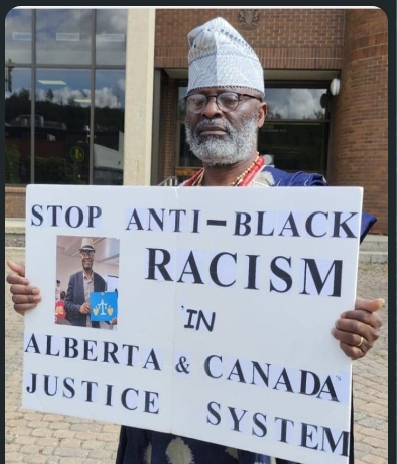
A Canada-based Nigerian Journalist and former Editor, Chief Femi Shodunke, has taken his fight against anti-Black racism directly to the streets, staging a one-man protest to draw attention to what he described as discrimination and unequal treatment of Black people in Canada.
For Shodunke, the protest was more than a public demonstration.
It was personal.
The Nigerian Journalist, who has lived and worked in Canada, said his decision to stand alone in protest was informed by experiences he claimed to have personally encountered.
“I’ve experienced it,” Shodunke said, making it clear that his concerns about racism were not based merely on stories told by others.
His action has brought renewed attention to the experiences of Black people living in Canada and the wider debate over racial discrimination in a Country known for its multicultural identity.
Shodunke, a Journalist and publisher of the Canada-based online Newspaper GatewayMail, has been outspoken on issues affecting Nigerians, Africans and people of African descent living outside the continent.
Rather than remain silent about what he considers discriminatory treatment, the former editor chose to make his concerns visible through a one-man protest.
The demonstration, although carried out without a large crowd behind him, carried a powerful message: that an individual can still raise his voice against an issue he believes deserves public attention.
For Shodunke, racism is not simply a subject for academic discussions, political speeches or social-media debates.
It is an experience that, according to him, has touched his own life.
His protest comes against the backdrop of longstanding discussions in Canada about anti-Black racism, racial profiling and systemic discrimination.
Black Canadians and members of the African diaspora have continued to raise concerns about discrimination in areas including employment, policing, education, healthcare and other aspects of public life.
Studies and institutional reviews in Canada have also examined the impact of systemic and structural racism on Black and other racialised communities.
Shodunke’s protest has therefore added an individual voice to a much larger conversation, one that continues to challenge governments, institutions and members of society to examine how Black people are treated.
The Nigerian Journalist has also been involved in diaspora community affairs.
He previously served as the National Public Relations Officer of the Egba National Association USA and Canada, giving him a platform within the Nigerian community in North America.
His media activities have equally provided an avenue for him to report and comment on issues affecting Nigerians and other Africans living abroad.
But his latest action takes the issue beyond Journalism.
By stepping out himself, Shodunke has transformed his concerns into a visible personal statement against discrimination.
The protest also highlights the difficult position sometimes faced by immigrants and members of minority communities who must navigate a new society while confronting questions of identity, race and belonging.
For many Black immigrants, the promise of a better life abroad can coexist with painful experiences of prejudice.
That tension has continued to fuel conversations within African communities in the diaspora about whether racism is being adequately confronted by governments and institutions.
Shodunke’s message is that silence should not be mistaken for acceptance.
His decision to protest alone suggests that the size of a crowd does not necessarily determine the importance of an issue.
One person, one placard and one voice can sometimes force attention onto a problem that has remained hidden or ignored.
And for the Nigerian journalist, the issue is deeply rooted in lived experience.
“I’ve experienced it.”
Those four words capture the emotional centre of his protest.
They represent the frustration of someone who believes he has encountered discrimination and has decided that remaining quiet is no longer an option.
His action is also likely to resonate with members of the Nigerian and wider African diaspora who have experienced or witnessed racial discrimination in foreign countries.
While Canada continues to promote multiculturalism and inclusion, Shodunke’s protest serves as a reminder that the existence of diverse communities does not automatically eliminate prejudice.
The challenge, therefore, is not merely to celebrate diversity but to ensure that people of different races are treated with dignity, fairness and equal protection.
Global Mirror News gathered that Shodunke has consistently used journalism and community engagement to highlight issues affecting Nigerians and Africans in North America.
His latest protest has now placed the issue of anti-Black racism firmly at the centre of his public advocacy, with the journalist insisting through his action that discrimination must be confronted rather than ignored.
For a man who says he has personally experienced racism, the protest was not just about making noise.
It was about being heard.