
Tinubu Orders EFCC to Unfreeze Osun Account, Says Timing Embarrassing
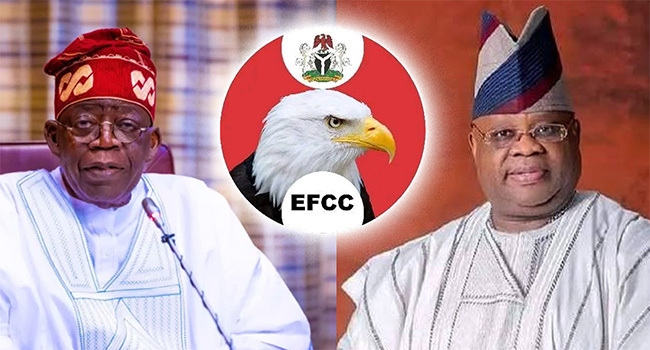
President Bola Ahmed Tinubu has directed the Economic and Financial Crimes Commission (EFCC) to return to court and seek the immediate withdrawal of the order restricting access to the Osun State Government’s bank account.
The President said he was deeply embarrassed by the timing of the EFCC’s action, particularly because it came only days before the Osun State Governorship election.
Global Mirror News gathered that the EFCC obtained a court order on August 5, 2026, restricting the State Government’s access to its account.
The development generated political and public reactions, with concerns raised over the possible impact of the restriction on the State Government’s ability to carry out its responsibilities ahead of the election.
In a statement personally signed by him on Thursday, President Tinubu said his concern was not with the EFCC’s constitutional and statutory responsibility to investigate suspected financial crimes, nor with its use of lawful judicial processes.
Rather, he said, the timing of the action was inappropriate given the closeness of the Osun Governorship election.
Tinubu explained that decisions taken by Federal institutions are often associated with the President, even when he has no prior knowledge of such actions.
He said this was why the timing of the EFCC’s decision had become a source of concern to him.
The President maintained that anti-corruption and law-enforcement Agencies must be allowed to operate independently, professionally and within the limits of the law, without fear, favour or political interference.
According to him, strong institutions remain essential to democratic governance and the rule of law.
However, Tinubu stressed that the proximity of the Osun governorship election made the EFCC’s action capable of creating an impression that a federal agency was being used to interfere in the electoral process.
He therefore directed the EFCC to immediately approach the court to vacate the restriction and discontinue any action it had instituted against the Osun State Government in connection with the matter.
Tinubu said the intervention was necessary to protect public confidence in the integrity, credibility and fairness of the democratic process.
EFCC Defends Its Action
The EFCC has, however, maintained that its action was not politically motivated and was part of an investigation into suspected financial irregularities involving Osun State funds.
The Commission reportedly linked its investigation to alleged unusual transfers of public funds to corporate entities.
EFCC officials have insisted that the restriction was carried out within the commission’s legal powers and was intended to prevent the possible movement or diversion of funds while investigations continue.
The Commission’s Director of Public Affairs, Wilson Uwujaren, also defended the Agency’s position, stressing that similar measures had been taken in other states where investigators detected suspicious financial transactions.
The EFCC said its investigation into the Osun State Government had been ongoing since March and involved allegations concerning the management of ecological and intervention funds.
Some state officials, including the Accountant-General, were reportedly invited and interviewed as part of the investigation.
Adeleke, Opposition Parties React
The restriction had earlier attracted criticism from Osun State Governor Ademola Adeleke and political groups, who questioned the timing of the EFCC’s action.
Adeleke was reported to have directed the state’s Attorney-General and Commissioner for Justice to challenge the restriction in court.
The development also attracted reactions from opposition political figures, who raised concerns about the independence of anti-corruption agencies and the possibility of their actions being perceived as political interference, especially during an election period.
Former Vice President Atiku Abubakar questioned the claim that the EFCC operates independently, arguing that the President’s directive to the commission to return to court and discontinue the action had raised fresh questions about the relationship between the Presidency and anti-graft agencies.
The controversy has consequently shifted the national conversation beyond the immediate issue of the restricted account to broader questions about institutional independence, the fight against corruption and the need to protect the credibility of Nigeria’s electoral process.
With the Osun governorship election approaching, President Tinubu’s intervention is expected to remain a major subject of political debate, particularly over how government agencies should conduct investigations involving state governments during sensitive electoral periods.
Global Mirror News learnt that the President’s directive does not prevent the EFCC from continuing any legitimate investigation into alleged financial misconduct. Instead, the immediate issue is the withdrawal of the court-backed restriction on the state government’s account, with any further legal action expected to follow due process.